Reflections by Elma Ósk Thorarinsson and Isabelle Buerger
The day before the doctoral consortium, we arrived in Barcelona with a shared sense of anticipation. We had first met online through IESE’s Organizing the Climate Transition course in spring, and were curious to see how those early conversations would translate in person at the GRONEN doctoral consortium. We met at Mescladís del Pou in downtown Barcelona. This café, a social enterprise focused on inclusion and sustainability, was not just as a convenient meeting point, but also a setting that reflected our shared values. Over glasses of vermouth, our conversation quickly moved beyond introductions. We spoke about our institutions and expectations for the conference, but also about growing up across countries as third culture kids. What began as a personal exchange became a useful reference point: the experience of navigating multiple contexts, adapting to different environments, and assembling a sense of belonging across them. By the time we parted ways after a walk along the beach, we carried that idea with us into the days ahead.
This perspective that we had settled into during our informal pre-meeting was instrumental in how we entered the first morning of the consortium. Seeing familiar faces helped ease us into the day, but more striking was how naturally conversations moved beyond surface-level exchanges. Questions like “Where are you based?” or “What field are you in?” rarely had simple answers. Instead, they opened up discussions about interdisciplinary work, institutional movement, and evolving research identities. What we had framed the day before in personal terms reappeared here in academic form: many of us were, in different ways, navigating in-between spaces. Importantly, these were not just mundane background—they shaped the kinds of challenges we face as PhD researchers, and the kinds of support we seek from a community like GRONEN.
This connection became explicit during the World Café session led by Katrin Heucher and Simone Carmine, following an opening by Valentina De Marchi and Tobias Hahn. Together, the doctoral cohort selected four themes that captured shared challenges: academic publishing, professional networks, interdisciplinary work, and defining one’s “academic home.” These themes anchored the discussions that followed, but also served as a kind of diagnostic: they made visible what early-career researchers in the GRONEN community are actively grappling with, and where collective reflection is most needed.
As discussions unfolded across tables, we took on different roles: Isabelle remained with one group as a notetaker, while Elma moved between groups to follow multiple discussions.
Isabelle’s POV
In the group that I accompanied, the focus was on the question: where is my academic home? What initially seemed like a definitional exercise became more revealing over time. Participants compared disciplines, departments, and research communities, testing where and how they felt a sense of fit. A recurring metaphor was that of a house within a neighborhood—connected to shared structures, but not fully defined by them. This framing made an underlying tension visible: the expectation that an academic path should be clearly anchored, versus the reality of more fluid, constructed forms of belonging. What emerged was less a clear answer and more a shift in perspective—away from searching for a single, fixed home, and toward recognizing belonging as something that can be actively shaped. For doctoral researchers, this reframing is not trivial: it directly affects how we position our work, choose collaborations, and navigate institutional expectations.
Elma’s POV
Moving between tables, I encountered similar patterns across discussions on publishing, networking, and academic identity. What stood out was not only the topics themselves, but how participants approached them. There was a consistent willingness to engage openly, to ask clarifying questions, and to acknowledge uncertainty without immediately trying to resolve it. Rather than treating non-linear paths as a weakness, many framed them as a shared condition of early academic careers—particularly in fields shaped by complex, interdisciplinary problems like sustainability. This kind of exchange is itself part of the value of the GRONEN community: it creates space to articulate challenges that are often felt individually but rarely discussed collectively.
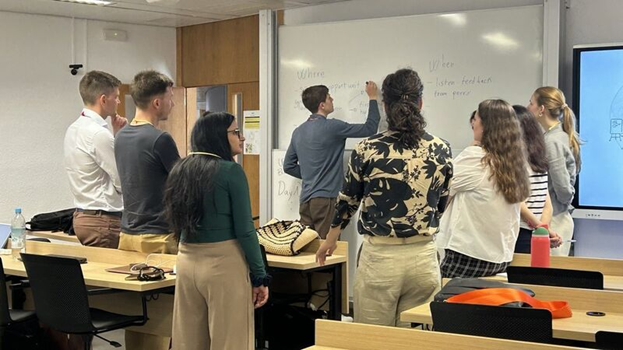
Image: Elma’s group discussing academic publishing
Following a lunch outside in the sun, the afternoon began with a “speed dating” session led by Annachiara Longoni. Framed as a fast-paced bingo-style activity, the session had us exchanging quick snippets—fun facts, small pieces of advice, and unexpected details about each other (ranging from musical talents to reminders like not drinking too much coffee). The pace was high and the interactions brief, with most of us focused on filling our cards, but that was part of the point. While the conversations remained necessarily surface-level, the format brought a sense of playfulness into the day. It broke up the intensity of the more substantive sessions and made it easier to approach one another afterwards.
The feedback circles that followed provided one of the most concrete learning moments of the day. In small groups, each doctoral researcher presented their extended abstract and received input from a senior scholar and peers. One insight that stood out was that, as a researcher, you are the only person who fully holds the complexity of your work. That makes it your responsibility to frame it in a way that allows others to engage meaningfully—and to actively seek feedback that aligns with the specific aspects you want to develop. This is a skill that is rarely taught explicitly, yet central to progressing in a PhD.
At the same time, listening to feedback on others’ work proved just as valuable. It exposed how different projects are interpreted, where misunderstandings arise, and how arguments can be strengthened. For the GRONEN community, this format is particularly valuable because it makes otherwise invisible processes of knowledge development more accessible—especially for those at earlier stages.
After a short break, the final session turned to the question of impact as an early-career scholar, moderated by Julian Jonathan Markus. The discussion grounded the idea of “impact” in practical considerations. From our perspectives, this resonated strongly with the responsibilities tied to qualitative research—particularly how interview-based insights are represented and translated into academic work. Impact, in this sense, is not only about reach, but about how carefully those perspectives are handled. At the same time, the panel broadened the notion of impact beyond publications, pointing to teaching, collaboration, and engagement with practice as equally meaningful avenues—especially early on. For a community like GRONEN, which sits at the intersection of research and societal relevance, this expanded view of impact is particularly important.
By the time we arrived at the Philippines Club overlooking Plaza Reial, the energy of the day had shifted rather than faded. Conversations flowed more easily, now grounded in shared experiences rather than initial introductions. Faces that had been only vaguely familiar that morning now carried context—research interests, challenges, and emerging ideas.
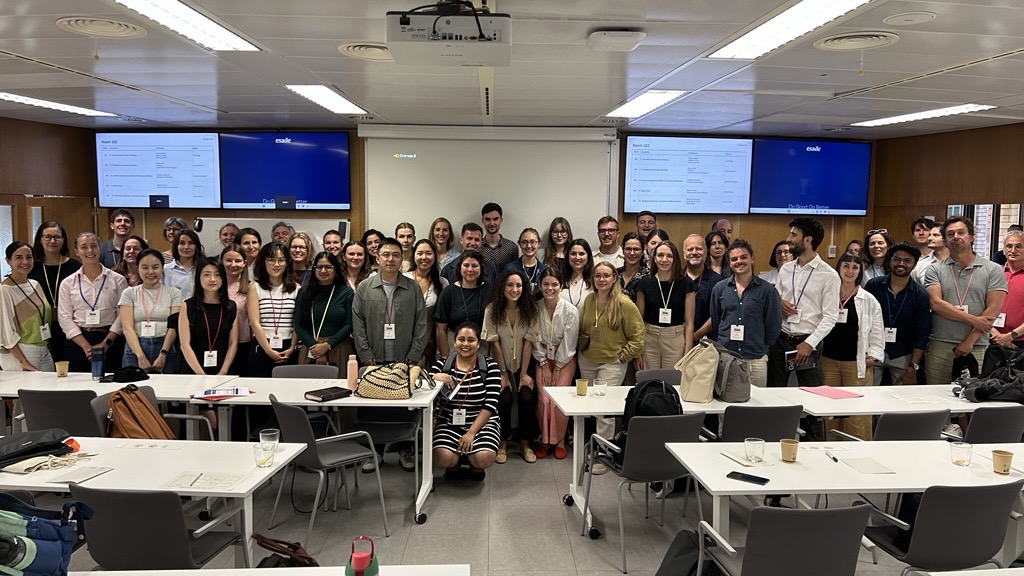
Looking back, the day had something of the feeling of a first day at camp: intense, slightly overwhelming, but structured in a way that made connection almost inevitable. Many of the facilitators had once been in the same position, and that continuity showed in how space was made for both uncertainty and exchange. What the day ultimately offered was not just orientation, but access—to ways of thinking, to shared challenges, and to a community that makes those challenges easier to navigate. For current and future GRONEN doctoral researchers, that may be its most lasting value.
Elma’s bio
Elma Ósk Thorarinsson is a PhD candidate at Rotterdam School of Management, Erasmus University. Her research explores facets of natural resource management through qualitative methods, with a focus on empirical contexts related to forest management and nature conservation. She is also an affiliated Research Fellow at the House of Sustainable Society at the Stockholm School of Economics. Prior to the PhD programme, she completed a MSc in International Business from Stockholm School of Economics and a master in International Management from CEMS Alliance. Her background spans economic history, international relations, and media studies, with practical experience in corporate sustainability and reusable packaging ecosystems. She can be reached at thorarinsson@rsm.nl or via Linkedin.
Isabelle’s bio
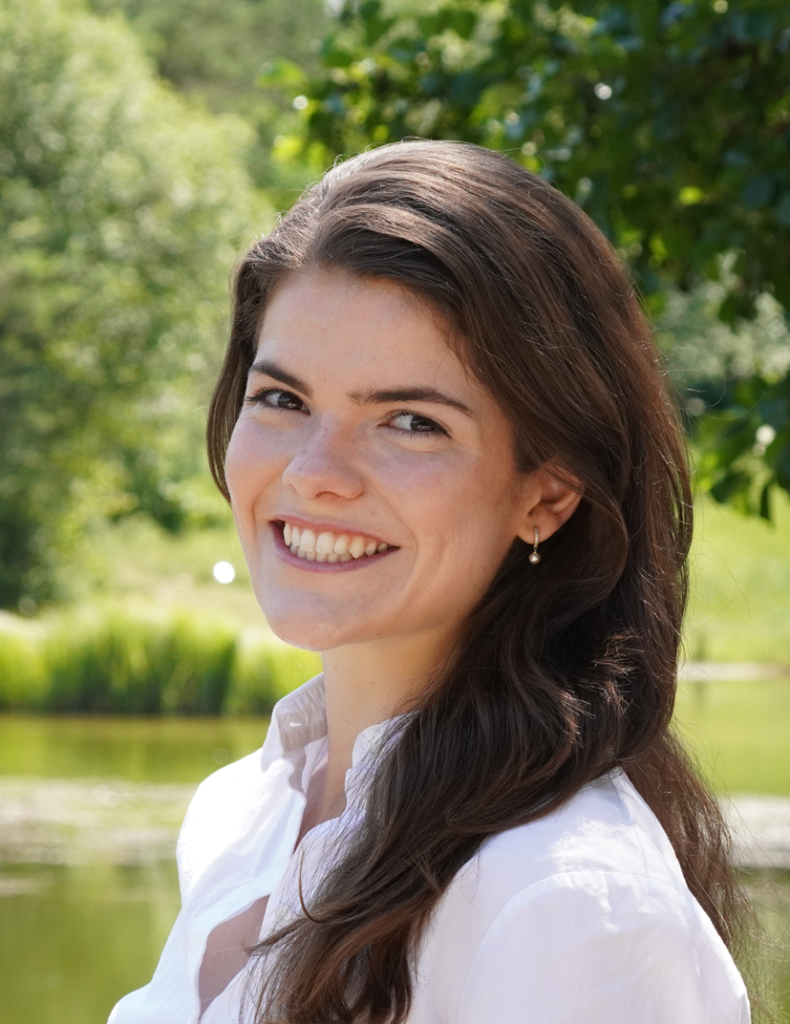
Isabelle Buerger is a doctoral candidate and research associate at the Chair of Sustainability Management at the University of St. Gallen’s Institute for Responsible Innovation, Sustainability and Energy. Her research focuses on value chain governance and sustainability transitions in agri-food systems, with particular expertise in biodiversity risk assessment and management. Before joining the PhD program in Business Administration (PMA) at St. Gallen, Isabelle worked with Migros, where she contributed to the development of the company’s biodiversity strategy, ESG risk analysis, and freshwater policy implementation. Her experience spans corporate sustainability, academic research, and grassroots initiatives, including work on regenerative agriculture, zero-waste business models, and sustainable food systems. Isabelle holds an MSc in Human Geography from the University of Zurich, with a minor in Agroecology from ETH Zurich, and an interdisciplinary BSc (Honours) in Governance, Economics, and Development from Leiden University College The Hague. Her methodological expertise includes qualitative research in multi-stakeholder contexts and sustainable supply chain analysis. Through her research, Isabelle aims to advance practical and scalable solutions for more resilient and biodiversity-positive food systems. She can be reached at Isabelle.buerger@unisg.ch or via Linkedin.
