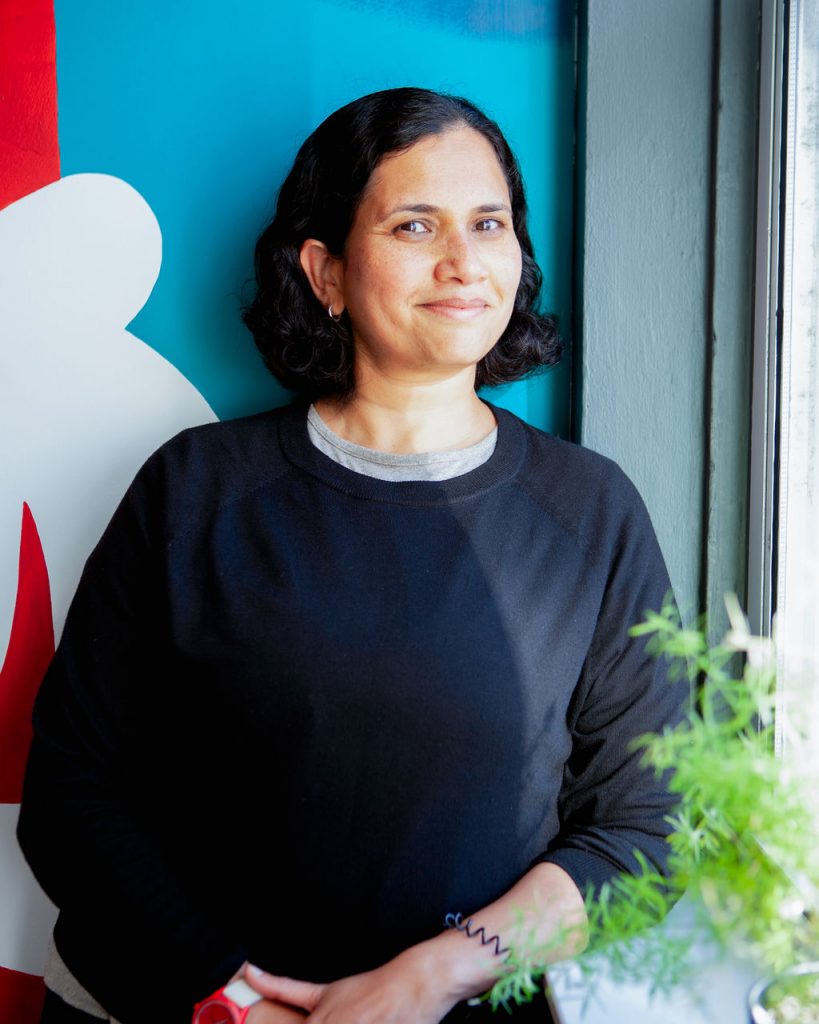
Kavitha Ravikumar recently completed her PhD at Loughborough University. She is based in the London campus and affiliated with both the Institute for International Management and Entrepreneurship and the Institute for Creative Futures. Her transdisciplinary research explores how the spatiality of organising can enable spaces that allow sustainability-aligned individuals to imagine desirable futures.
Here is Kavitha’s story.
What are the top three highlights, professional skills, or other experiences you have had during your time as a PhD student?
I began my PhD during the pandemic, and for the first year and a half, the ideas, discussions, and academia in general felt oddly distant and flattened into the screen of my computer. As soon as it was possible, I tried to apply to in-person events. The first two were the EGOS symposium in Vienna and a “More-than-Human” workshop at the Cluster of Excellence, Matters of Activity. Image. Space. Material, at Humboldt University of Berlin. I still remember the incredible feeling of learning from doing, being outside, part of a vibrant research community, the buzz of so many ideas and being swept up in energising conversations.
During fieldwork, another major highlight was a research visit at Aalto University in Finland. It offered me the chance to immerse myself in a different culture and academic environment, with its own flavour and traditions. Being welcomed so warmly by another scholarly community was wonderful; it also inspired many fresh ideas in my own research. The extended friendships and common interests cultivated during the visit continue to enrich my life.
Getting funded by an external organisation for a collaborative experimental project was another highlight. We were awarded small-grant funding from the Collective Imagination Practice Community (CIPC) for delivering collective artmaking workshops through sound and visual immersion in the UK and in Portugal. This resulted in three collectively imagined and executed artworks, an online blog publication describing the project and process, a conference presentation, and, finally, a gallery exhibition.
What inspired you to pursue a PhD?
Studying Environmental Economics and Development modules during my Economics bachelor’s degree first got me interested in the bigger picture around sustainability, but the generalised assumptions about human behaviour didn’t satisfy my understanding. So, I did a masters in Anthropology, and worked for a year in Auroville, an experimental eco-community in India.
I then worked in more corporate roles in consulting, innovation and strategy in the Healthcare, Chemicals and Materials sectors. Across these roles, I watched sustainability ideas dismissed as short-lived trends, and even the promising ones struggled to gain real support from key decision-makers. This made me even more curious about the deeper shifts needed to rethink what success and advancement mean. That curiosity eventually drew me back to academia, and I began my PhD at Loughborough University London to explore sustainability and the thinking behind it more deeply.
How would you summarize your research project(s) in a short title?
Acts of Organising: Exploring Contemporary Imagining of Desirable Futures.
In brief, what is the empirical method/context you are adopting in your thesis?
For my research, I embraced a developmental stance inspired by the principles of engaged scholarship. My approach was transdisciplinary. The primary research strand was qualitative, employing multi-sited, para-ethnographic methodologies and creative research methods to investigate a contemporary work-related organisational phenomenon.
Multi-sited ethnography is about following a question across different physical and online spaces and recognising that people’s experiences are shaped by multiple, interconnected contexts. A para-ethnographic approach takes practitioners’ insider knowledge seriously, allowing the researcher to be both a practitioner and a researcher, and, in doing so, dissolves the strict boundaries between researcher and subject. This approach encourages a more open, reflexive, and collaborative way of working. I incorporated contextually adapted visual methods to enhance the research of dynamic, fast-paced, and complex field sites through three distinct visual approaches: researcher-generated visuals as field data, researcher-generated visuals to process textual data, and researcher-artificial intelligence (AI)-generated speculative visuals for collaborative meaning-making.
I conducted fieldwork in London and Brighton (United Kingdom), Helsinki (Finland), and online, and explored how the organising of ‘extra-work events’ adjacent to everyday work can support the emergence of transformative ideas that might sow seeds of organisational and societal change.
Can you describe a “eureka moment” you might have had during your PhD?
The transition from industry to academia was challenging. The initial period often prompted a lot of introspection and identity adjustment, as it is not always easy to navigate the priorities and contradictions of working within institutionalised academic norms. Initially, I struggled with the apparent need to conform to formalised, often rigid styles of expressing ideas and writing them up. This was especially hard at the beginning, when everything is a bit hazy, and there are far too many unknowns.
But then, somewhere in the middle of all that struggle, I kept trying to find my space and reaffirm my purpose for doing the PhD. Then, one day, the writing came more easily, and I started having more than a few days that ended with a sense of energy and completion. Suddenly, it all seemed possible – and even a bit exciting.
What side projects, communities, or other initiatives are you involved with?
Getting involved in side projects and communities was probably the best thing about being a PhD student. There are so many opportunities. I am currently involved with the Art-Science Thematic Group at the Sustainability Transitions Research Network (STRN), the Systemic Design Association via its Relating Systems Thinking and Design (RSD) symposia, the Collective Imagination Practice Community, and attend sessions at reading groups like LEAP Lab Reading Group: Beyond the Gallery at the Centre for Research in the Arts, Social Sciences and Humanities (CRASSH), and ETHOS Seminars at Bayes Business School.
What three tips would you offer to new PhD students in your field?
- Attend conferences, write short papers if you can, and attend local research group presentations outside your own university. There is so much inspiration and knowledge out there, and opportunities to get and give feedback are truly valuable.
- If you are trying to do more experimental work and cannot find structured learning programmes for your interests, look outside your own institution. Many universities and organisations open their training sessions to students of other universities; sometimes all it takes is an email expressing your interest in attending.
- The PhD is a marathon. Pace yourself. Everything will take time, and often things will be redone many times. So, don’t lose touch with old friends or the world outside the University. They will help keep it real.
What hobbies or interests do you enjoy outside of work?
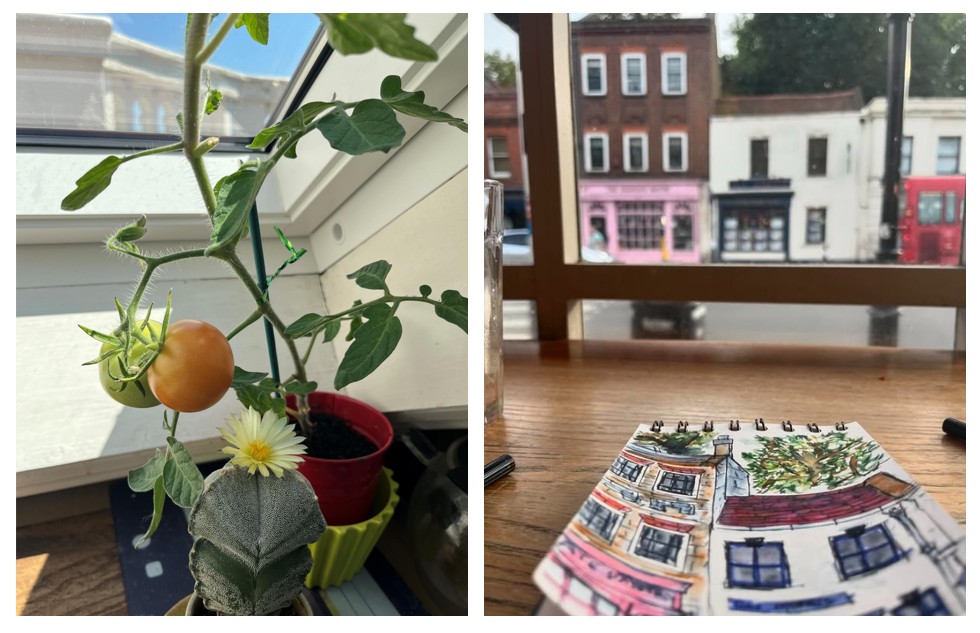
This is a difficult one! I love sea swimming, art and craft, poetry writing, travelling, photography, material experimentation through ceramics, organic materials and upcycling, as well as urban gardening.
Photo (right): Some of Kavitha’s favourite things…
In one or two sentences, what does the GRONEN community mean to you? Or the community of sustainability management scholars more broadly if you are new to GRONEN.
A few years ago, I attended a GRONEN reading group session as a scholar without a paper. It was such a positive experience. Everyone was invited to speak, and the participants gave thoughtful and useful feedback. This, for me, is what GRONEN is all about: a supportive and engaged scholarly community.
What’s next for you?
I have been teaching on the ‘Knowledge Economy’ module at University College London (UCL) this semester. I am also very fortunate to have a chapter, “Imagining futures in the present: Conceptualising prefigurative impulses through the politics of organising”, selected for publication in a book published by Palgrave Macmillan, which will be available in January 2026. The editors, S. Sareen and S. Juhola, were incredibly supportive, and the group of accepted authors formed a truly collegial community. Working in the prefiguration space is inherently inspiring, and I would love more opportunities to work on interdisciplinary and transdisciplinary academic research projects in the future.
Contact
You can contact Kavitha via LinkedIn.

Karelia Dagnaud is a doctoral candidate at the Aalto University School of Business, in Finland. In her research, she explores how researchers and business practitioners learn and organize for sustainability, specifically in the textile sector context.